Strategic Interoperability for Digital Health Operators: A Newfire Field Guide
Strategic interoperability means treating EHR integration as both a business and product decision – one that drives revenue, adoption, and long-term scale, not just technical compliance. Brendan Iglehart, Staff Healthcare Architect and Interoperability Practice Lead at Newfire Global Partners, has distilled more than a decade of hands-on experience supporting innovators with their integration projects into a practical Field Guide for digital health operators. This guide shows how to align integration scope with ROI, prioritize the right data and methods, avoid overbuilding, and scale interoperability deliberately.
Read on and be sure to download the Field Guide if you’re building, selling, or modernizing digital health products.
Why Interoperability Matters Now
Interoperability is no longer an accessory to digital health products. It’s the entry ticket. Without the ability to integrate into core systems like EHRs, vendors are effectively shut out of sales conversations before they begin.
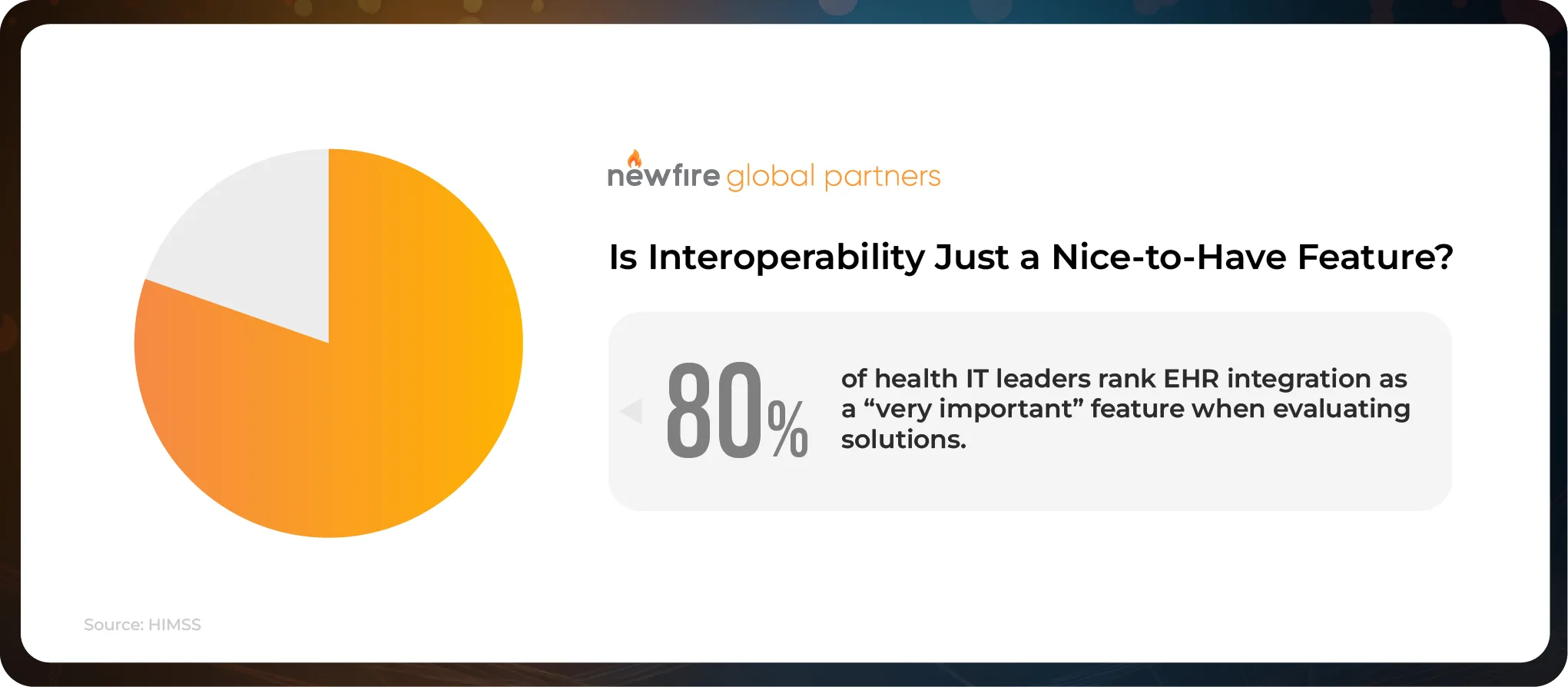
Given the current economic and reimbursement landscape, healthcare organizations are under pressure to maximize ROI and capital efficiency from their digital solutions. A March 2024 HIMSS survey underscores this reality: 80% of health IT leaders rank EHR integration as a “very important” feature when evaluating solutions. For product teams, that makes interoperability a prerequisite to unlocking pipeline opportunities and demonstrating ROI.
What convinces buyers to move forward isn’t the technical checkbox alone, but the advantages integration creates: smoother onboarding, clinician adoption, regulatory readiness, and customer stickiness. These benefits are what give interoperability its commercial power: they drive sales, protect margins, and ensure products can scale sustainably.

This guide outlines how to create an interoperability strategy that maximizes revenue, margins, and customer value, while minimizing onramp and engineering costs. We call this strategic interoperability: aligning integration requirements with your overall product vision while making the most of your resources.
Brendan Iglehart, Staff Healthcare Architect at Newfire Global Partners
What You Will Learn
- The core benefits of strong EHR integration: from faster onboarding to reduced churn.
- The principles product leaders should apply to maximize ROI and avoid wasted effort.
- How to define the right data needs instead of trying to “get it all.”
- The main approaches to integration and how to align them with business goals
- A view of the technology landscape — from legacy standards to FHIR, APIs, networks, and AI
- How digital health companies are structuring integration work, with real-world case studies.

How Do Digital Health Vendors Benefit From Integrating With EHRs?
EHR integration is no longer optional but a requirement to even be considered. But beyond clearing that bar, it also delivers real business value.
Here’s how integration strengthens the case for your product:
- Faster onboarding and adoption: Embed tools in the EHR to cut friction, speed onboarding, and improve satisfaction.
- Competitive differentiation: EHR compatibility is often the reason buyers choose one vendor over another.
- Increased stickiness and reduced churn: Becoming part of daily workflow raises switching costs and boosts retention.
- Regulatory compliance: Build on standards (e.g., FHIR) to lower compliance risk and avoid costly rework.
- Value optimization: Treat integration as a revenue lever to prioritize high-ROI connections and avoid overbuilding.
Four Principles to Maximize the ROI of Your Interoperability Strategy
Digital health vendors that see interoperability as a revenue enabler, not a compliance chore, are the ones that capture its full value. These four principles help ensure every dollar and hour spent on integration delivers measurable returns:
- Quantify the problem you’re solving: Define the specific “why” behind the integration and the value it will create to guide scope and priorities.
- Align investment with revenue opportunities: Prioritize integrations that support high-impact features and drive measurable ROI.
- Don’t boil the ocean: Integration isn’t a binary (integrated/not integrated) — start with the depth your users need now, and expand over time.
- Stakeholder management is critical: Identify clear benefits for each stakeholder group early to build buy-in and support adoption.
Choosing the Right Integration Strategy
This guide offers a practical view of how to approach interoperability — from choosing the right technical method and configuring your team, to understanding what AI can and can’t do yet. It also covers a question many teams overlook: when integration might not be the right move at all.
When Not to Integrate With EHRs and Other Systems
While integration is essential long-term, there are times when it’s better to wait. Consider delaying or limiting integration if:
- Customer workflows vary widely, and you haven’t identified common patterns yet.
- Core product features are still evolving, risking costly rework.
- You’re in early-stage discovery or pilot mode, where manual data exchange allows faster iteration.
In these cases, start with lightweight solutions, validate the value, and deepen integration only when the path is clear.
Definitions and Use Cases of Current Integration Methods
There’s no one-size-fits-all approach to integration. Newfire’s guide to strategic interoperability breaks down the most common methods: what each one is, how it works, and what to consider when evaluating vendors. It also includes a high-level comparison to help you understand trade-offs and decide which methods best support your goals.
While many teams start with one approach, most end up combining several of the following as their integration needs grow:
- Legacy Methods: HL7v2.x, HL7v3.x, X12/EDI, etc
- FHIR APIs
- Proprietary API Integrations
- Robotic Process Automation
- Networks such as QHINs, State and Regional HIEs, Carequality
- Extracts and Flat File Exchange
- Direct to Database
How Is AI Evolving Interoperability?
AI is beginning to shape interoperability in promising but still early ways. That being said, there are key areas to watch, including tools that speed up data mapping and integration workflows, algorithms that improve patient matching across fragmented systems, and language models that convert unstructured notes into structured formats like FHIR. These applications are not yet mature, but they’re worth tracking as your strategy evolves.
Use the guide to stay ahead and be first in line when AI starts making a real difference.
Assembling an Effective Integration Team: Roles and Approaches
Many teams get this wrong by underestimating the breadth of work and expertise required to execute an integration successfully. Integrations involve multiple specialized roles across product, engineering, UX, and implementation. Even early projects may need support from software engineers, product managers, UX designers, integration engineers, project managers, and support staff.
While it’s common to combine roles early on, that approach doesn’t scale. As integration demands grow, relying on team members with other responsibilities creates bottlenecks and limits impact.
Most companies choose between two models:
- In-house teams offer greater control and long-term cost stability but require higher upfront investment and carry hiring risk.
- Outsourced teams provide faster ramp-up and flexibility, but can reduce visibility and increase long-term costs.
Choosing the right model depends on your current scale, speed requirements, and resource availability.
About the Author
Brendan Iglehart has served as a technical implementer and solutions engineer for 4 digital health vendors over the last 12 years and is now the Interoperability Practice Lead and Staff Healthcare Architect at Newfire Global Partners, a product advisory and software development firm. During his time at Redox, Brendan guided interoperability strategies for over 250 companies ranging from pre-seed to Fortune 50. Previously, while at Medically Home, he helped design and implement the company’s first EHR integrations to enable acute care at home workflows at Mayo Clinic, Kaiser Permanente, and UNC. Like many in the digital health space, he began his career at Epic, where he led implementation of Epic’s oncology and research modules at organizations including Jefferson Health and Baylor College of Medicine. Brendan is based in Chicago.
About Newfire Global Partners and Newfire Advisory Services
Founded in 2016, Newfire Global Partners is an IT services and advisory firm dedicated to healthcare and digital health. With teams across the United States, EMEA, Latin America, and Asia Pacific, Newfire brings together deep healthcare domain knowledge, advanced engineering capabilities, and expertise in AI and machine learning. The company partners with clients to design and scale innovative solutions that are secure, compliant, and built for long-term impact, helping healthcare organizations improve outcomes, accelerate growth, and navigate complex regulatory and market dynamics.
FAQ
- What is strategic interoperability in digital health?
Strategic interoperability is the practice of aligning EHR integration decisions with a digital health product’s business goals, user workflows, and long-term roadmap—rather than treating integration as a standalone technical task.
- Why is EHR integration considered a prerequisite for digital health vendors today?
Most healthcare buyers now view EHR integration as a baseline requirement. Without it, vendors are often excluded from evaluations before commercial discussions begin, regardless of product quality.
- How does interoperability impact revenue and ROI?
Well-designed integration supports faster onboarding, higher clinician adoption, reduced churn, and stronger differentiation in competitive sales cycles—all of which directly influence revenue and margin performance.
- Is interoperability mainly a compliance requirement?
No. While regulatory alignment is important, interoperability creates its real value when it improves workflows, embeds products into daily clinical use, and supports scalable growth.
- What are the biggest mistakes digital health companies make with EHR integration?
Common mistakes include integrating without a clear business objective, trying to access all available data instead of prioritizing what’s needed, and overinvesting in depth before product-market fit is established.
- How do product teams decide what data to integrate?
Effective teams start by defining the decisions or workflows the data must support. Data requirements are shaped by user needs and business outcomes—not by what systems technically allow access to.
- What integration approaches are most common in healthcare today?
Most digital health companies use a combination of approaches over time, including legacy standards (HL7, X12), FHIR APIs, proprietary APIs, health information networks, flat file exchanges, and database-level integrations.
- When does it make sense to delay EHR integration?
Integration may be delayed when workflows are not yet standardized, core product features are still changing, or teams are in early discovery phases where manual data exchange enables faster learning.
- How is AI influencing interoperability today?
AI is beginning to assist with tasks like data mapping, patient matching, and converting unstructured data into structured formats. These applications are still emerging and should be monitored rather than relied on as primary integration strategies.
- What roles are required for a successful interoperability effort?
Interoperability typically spans product management, engineering, UX, integration specialists, implementation, and support. As complexity grows, dedicated roles become necessary to avoid bottlenecks and rework.
- Should companies build integration teams in-house or outsource them?
In-house teams offer greater control and continuity, while outsourced teams provide speed and flexibility. The right choice depends on scale, timeline, and long-term integration strategy.
- Who is this interoperability guide for?
The guide is designed for digital health product leaders, founders, and operators responsible for scaling products, supporting enterprise sales, and aligning technical decisions with business outcomes.
- What makes this guide different from other interoperability resources?
Rather than focusing solely on standards or APIs, the guide frames interoperability as a strategic lever—connecting technical choices to revenue, adoption, and long-term product success.
- Who created the Strategic Interoperability Field Guide?
The guide was written by Brendan Iglehart, Staff Healthcare Architect at Newfire Global Partners, drawing on over a decade of experience implementing integrations for digital health companies ranging from early-stage startups to Fortune 50 enterprises.
Download the Field Guide to Strategic Interoperability
and Get a Clear, Practical Framework
Fill out the form to receive instant access to the guide – delivered straight to your inbox.